
 Marika
A 65% chance on Polymarket. A 59% chance on Kalshi.
Same headline. Different probabilities.
Which one is right?
Possibly both. Because prediction markets don't simply measure what people think will happen. They turn those opinions into tradable contracts, and each platform has its own liquidity, pricing mechanism, fees, and rules for determining the winner.
In 2026, the prediction market landscape extends well beyond Polymarket and Kalshi. Platforms such as Hyperliquid, Gemini, Myriad, Manifold, ForecastEx, Crypto.com, and Pascal approach event trading in different ways.
Our guide compares nine prediction market platforms by how they price outcomes, where liquidity comes from, what trading costs look like, and how developers can access their data. On top of that, we examine how FinFeedAPI's Prediction Markets API helps researchers analyze prices, trades, order books, and historical market activity across venues.
1. Why the Same Event Can Have Different Probabilities
A prediction market turns a question into a financial contract.
Consider a hypothetical market:
Will Bitcoin exceed $120,000 by December 31?
A YES contract trading at $0.65 implies a market price corresponding to a 65% probability. If the contract resolves YES, it typically pays $1. If it resolves NO, it pays nothing.
But that price is determined by trading, not by an independent probability calculator.
Three mechanisms explain much of the variation.
Order books: Prices come from buyers and sellers
Platforms such as Polymarket, Kalshi, and Pascal use order books.
Traders submit bids and offers. A transaction occurs when compatible orders match. The best available prices and the amount of liquidity behind them determine what another trader can actually buy or sell.
A displayed probability of 65% doesn't mean a trader can purchase $100,000 worth of contracts at $0.65.
The order book might contain only 200 contracts at that price. A larger trade would consume additional levels, increasing the average execution cost.
Automated market makers: Prices follow a liquidity curve
Other platforms use automated market makers (AMMs).
Instead of requiring another trader's resting order at every price, an AMM adjusts the cost of buying or selling according to its liquidity and pricing formula.
Buying YES pushes its price higher. Selling YES pushes it lower.
The amount of liquidity determines how much the probability moves for a given trade.
Hybrid models: Combining multiple sources of liquidity
Some platforms combine order books with AMMs or use alternative mechanisms that share liquidity between complementary outcomes.
Manifold combines limit orders with an AMM. Myriad supports AMM and order-book markets. Hyperliquid HIP-4 merges complementary YES and NO liquidity within its order-book design.
The distinction matters because the probability shown on a screen is not necessarily the price at which a meaningful position can be executed.
And pricing mechanics aren't the only difference. Contract definitions matter just as much.
A market asking whether Bitcoin touches $120,000 during December is not equivalent to one asking whether Bitcoin closes above $120,000 on December 31.
Before comparing prices, make sure the contracts describe the same event.
2. Prediction Market Platforms Compared: 2026
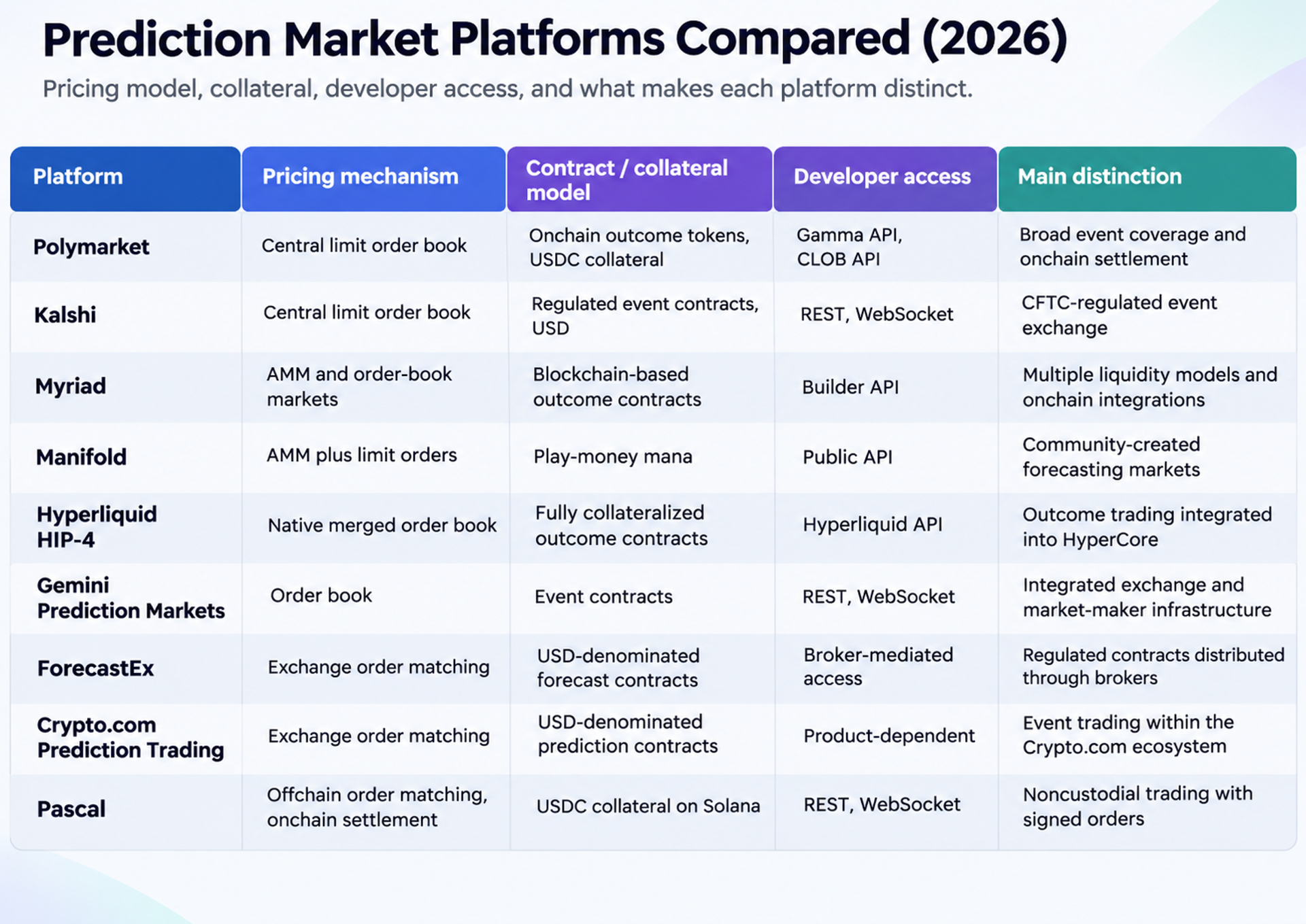
Product availability, fees, and developer functionality vary by region and market. Details reflect documentation reviewed in November 2026.
1. Polymarket: Best for broad event coverage and onchain market research
Polymarket is one of the most recognizable prediction market platforms. Its markets cover politics, economics, crypto, sports, technology, and other real-world events.
How prices form: Polymarket uses a central limit order book. Buyers and sellers determine outcome prices through matching orders rather than an AMM pricing curve.
Fees: Polymarket's July 2026 fee schedule uses category-dependent taker fees, calculated according to the contract price. Makers pay no trading fee under that schedule, and geopolitical and world-event markets are fee-free. Other transaction costs may still apply.
For example, the published crypto-market taker formula is:
fee = contracts × 0.07 × price × (1 − price)
For 100 contracts purchased at $0.50, this produces a $1.75 trading fee.
Resolution: Polymarket's international markets use the UMA Optimistic Oracle for outcome resolution, with a dispute process for contested results. Individual contract rules determine precisely what qualifies as YES.
Developer access: Its CLOB and market-data APIs support order books, market discovery, and trading-related integrations.
Where it fits: Researchers studying event-driven trading, market reactions to news, and historical changes in implied probabilities.
The main consideration is liquidity. A popular election market and a niche entertainment market can have vastly different spreads, depth, and execution costs.
2. Kalshi: Best for regulated event-contract trading
Kalshi is a US-regulated prediction market exchange offering contracts tied to economic releases, politics, sports, weather, and other events.
How prices form: Traders place orders against a central order book. A YES contract's price reflects the terms at which market participants are willing to trade.
Fees: Kalshi's general July 2026 schedule uses a variable fee:
fee = contracts × 0.07 × price × (1 − price)
The actual charge is subject to the exchange's rounding rules, exemptions, and market-specific schedules. Certain resting orders that execute are subject to a lower maker-fee formula.
Resolution: Contracts settle according to exchange-defined rules, including the specified data sources, deadlines, and applicable determination procedures.
Developer access: Kalshi provides REST and WebSocket APIs for market data and trading workflows.
Where it fits: Research involving regulated US event contracts, economic indicators, and structured contract specifications.
A key limitation in cross-platform comparisons is the wording of each contract. Kalshi's settlement criteria may differ from a seemingly identical question on Polymarket.
3. Myriad: Best for studying AMM-based prediction markets
Myriad offers blockchain-based prediction markets across crypto, finance, sports, politics, and other topics.
How prices form: Many Myriad markets use an automated market maker. Prices adjust as participants buy and sell outcome shares. Its developer documentation also describes order-book markets, so the pricing model depends on the individual market.
Fees: Myriad documents AMM buy fees ranging from 0% to 2%, depending on the market. Its application also lists a small transaction charge to cover gas costs. Developers should retrieve the applicable fee configuration rather than assume a uniform rate.
Resolution: Outcome settlement follows the market's resolution criteria. Users should review the specific conditions before treating a listed probability as comparable with another exchange.
Developer access: Myriad provides builder documentation and APIs for market data and integrations.
Where it fits: Studying how liquidity curves influence probabilities and comparing AMM pricing against order-book execution.
4. Manifold: Best for community forecasting and research experiments
Manifold takes a different approach.
Its markets are primarily social forecasting instruments, created by community members and traded using mana, an internal play-money currency that cannot be converted into cash.
How prices form: Manifold combines limit orders with an AMM. Trades first execute against eligible limit orders and then use automated liquidity when necessary.
Fees and participation: Users receive mana when joining and can use it to create or trade markets. Since mana is not redeemable for money, Manifold prices should not be interpreted as equivalent to cash-backed trading opportunities.
Resolution: Community-created markets depend on their individual resolution specifications and applicable platform mechanisms.
Developer access: Manifold provides a public API suitable for building bots, analytics, and forecasting applications, subject to its usage and licensing rules.
Where it fits: Measuring collective expectations, experimenting with forecasting models, and researching questions that may not attract enough demand for a real-money market.
Manifold is particularly interesting because it lets researchers examine forecasts in an environment with different financial incentives from cash-backed exchanges.
5. Hyperliquid HIP-4: Best for native onchain outcome-market infrastructure
Hyperliquid expanded its infrastructure with HIP-4, introducing fully collateralized outcome contracts alongside its established trading ecosystem.
How prices form: HIP-4 uses native order books with complementary YES and NO positions.
A bid to buy YES at $0.60 is economically linked to an offer to sell NO at $0.40. The protocol's merged-book mechanism allows the two sides to share liquidity.
Fees: Hyperliquid's HIP-4 documentation describes zero protocol trading fees during its initial testing period, although builder fees may apply. Those terms may change as the product develops.
Resolution: Outcomes settle according to the market's defined conditions. Contracts are fully collateralized and do not involve the leverage or liquidation mechanics of perpetual futures.
Developer access: Hyperliquid offers native API functionality for outcome market metadata and trading.
Where it fits: Researchers exploring order-book microstructure, collateralized event contracts, and the intersection of derivatives infrastructure and prediction markets.
Unlike many traditional prediction platforms, HIP-4 is designed as a broader outcome-contract primitive rather than exclusively as a venue for forecasting news events.
6. Gemini: Best for prediction markets integrated with exchange APIs
Gemini provides prediction-market infrastructure with dedicated event discovery, order management, and market-data interfaces.
How prices form: Tradable contracts have bids, asks, and order-book depth. Prices are determined through exchange trading.
Fees: Applicable rates and incentives should be checked against Gemini's current terms and market-specific schedules. Its developer platform also documents maker rebates and liquidity rewards.
Resolution: Event metadata provides the relevant contract conditions, expiration information, and settlement data where available.
Developer access: Gemini's Prediction Markets API includes REST endpoints for discovery and order management, plus WebSocket streams for prices and depth.
Where it fits: Developers building event-trading infrastructure within an established exchange API environment.
7. ForecastEx: Best for broker-accessible regulated forecast contracts
ForecastEx operates a regulated marketplace for event-based contracts, with access through participating brokers such as Interactive Brokers.
How prices form: ForecastEx contracts are quoted in USD, with YES and NO positions representing opposing outcomes. Contracts available through Interactive Brokers are quoted between $0.01 and $0.99 in one-cent increments.
Fees: The ForecastEx fee schedule specifies a $0.01 transaction fee per contract per side. Interactive Brokers advertises zero additional commission for ForecastEx contracts, although other account or product costs may apply.
Resolution: Contracts rely on predefined event conditions and reference sources, subject to ForecastEx's exchange rules.
Developer access: Access to contracts and related data depends on the broker and its supported interfaces rather than a universal public ForecastEx trading API.
Where it fits: Investors and researchers examining regulated event contracts alongside traditional brokerage products.
8. Crypto.com Prediction Trading: Best for event contracts within an existing trading app
Crypto.com provides prediction trading through its derivatives ecosystem, with contracts covering sports, crypto, financial indicators, and other event categories.
How prices form: Contracts are traded using exchange-based pricing. Available prices depend on active orders and the liquidity of the specific market.
Fees: Its published schedule distinguishes sports and prediction contracts from contracts covering crypto, FX, commodities, and indices.
For sports and other applicable single-event contracts, taker fees use:
0.07 × contracts × price × (1 − price)
Other categories can have a fixed $0.02 charge per contract.
Resolution: Settlement follows the stated contract rules and the applicable regulated exchange framework.
Developer access: Developers should confirm which prediction-trading data and execution features are available through their specific Crypto.com integration. General exchange API availability does not automatically establish support for every prediction contract.
Where it fits: Users looking for event trading alongside existing crypto and derivatives products, subject to geographic eligibility.
9. Pascal: Best for noncustodial prediction-market trading on Solana
Pascal combines a Solana-based collateral system with an offchain matching engine.
How prices form: Traders submit signed orders. The matching engine identifies compatible orders, and matched trades settle through the onchain program.
Fees: Pascal publishes market-specific maker and taker parameters. Its documented default taker-fee rate is 0.02, applied to the probability-weighted trade formula:
fee = contracts × price × (1 − price) × 0.02
Maker rebates are also supported under the documented default configuration.
Resolution: Individual markets contain rules and settlement specifications that determine the outcome.
Developer access: Pascal's API documentation covers REST, WebSocket, order submission, and market-data retrieval.
Where it fits: Developers interested in noncustodial event trading, signed orders, and onchain settlement without onchain matching for every order.
3. Why Prediction Market Fees and Liquidity Matter More Than the Displayed Probability
Two platforms might both quote YES at $0.60, but that doesn't mean a trader receives the same execution price.
Consider a hypothetical purchase of 1,000 YES contracts.
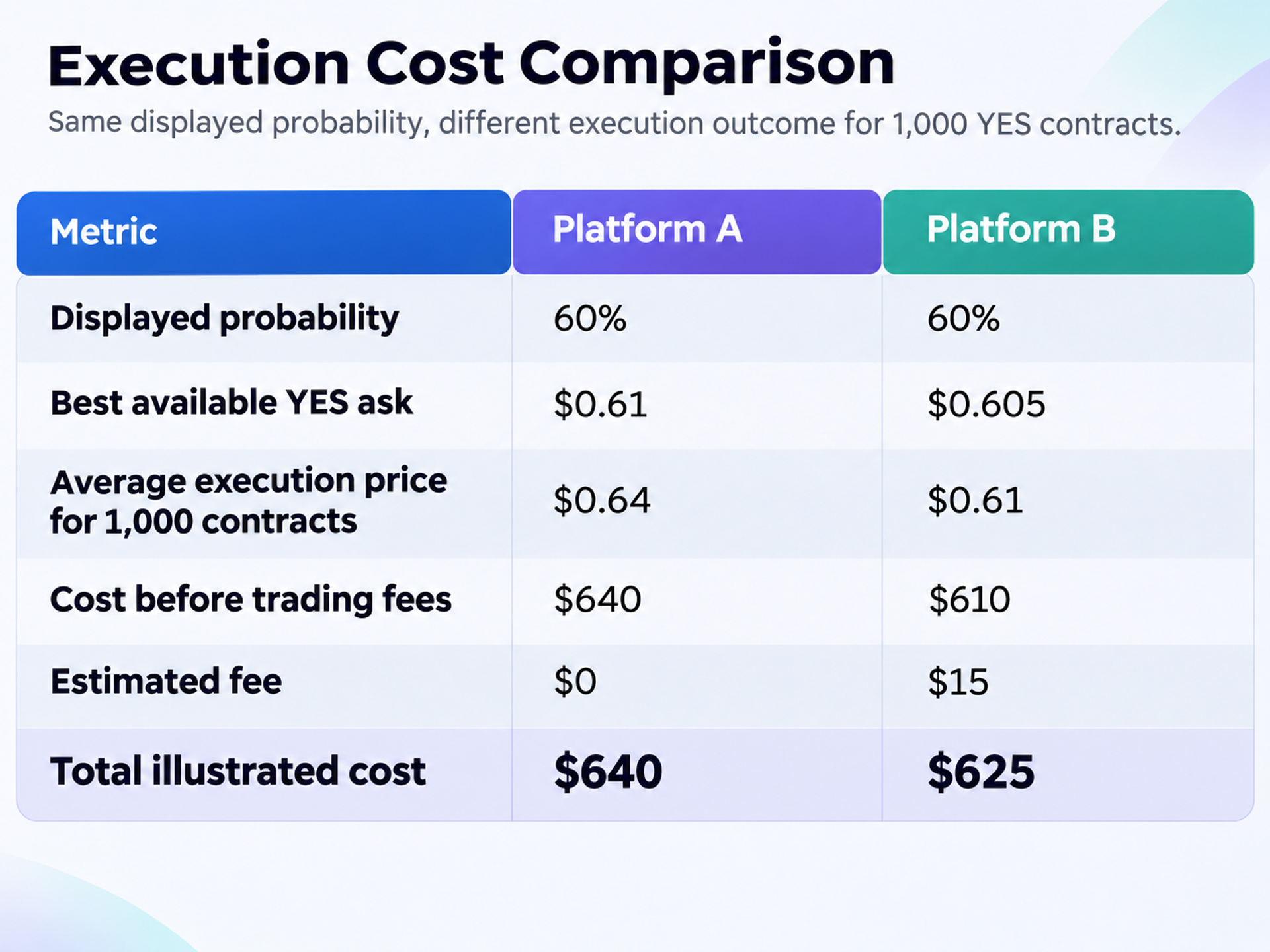
Illustrative figures only, not observations from a live exchange.
Even with a higher trading fee, Platform B offers a lower total cost because its order book provides better depth.
This is why market volume, quoted probability, and transaction costs need to be studied separately.
Volume tells you how much activity occurred during a period. It doesn't reveal how much liquidity is available right now.
Order-book depth tells you how much can be bought or sold at different prices.
The bid-ask spread reflects the immediate difference between buying and selling prices.
And historical trades show how market participants actually transacted, rather than just what a quote screen displayed.
For prediction-market researchers, that distinction is essential. A sudden move from 40% to 60% could reflect a major information update. But it could also result from a relatively small trade in a thin market.
Without the underlying activity and liquidity data, it's difficult to tell the difference.
4. How Prediction Markets Resolve Events, and Why It Changes the Odds
The contract price is only half the story.
The other half is the resolution rule.
Imagine two markets with almost identical titles:
- Market A: Will Bitcoin trade above $120,000 at any point before December 31?
- Market B: Will Bitcoin close above $120,000 on December 31?
Bitcoin could briefly trade at $125,000 and then finish the year at $115,000.
Market A would resolve YES, assuming its specified price source and other conditions were satisfied.
Market B would resolve NO.
The same underlying asset. Two different outcomes.
Resolution rules can vary in several ways:
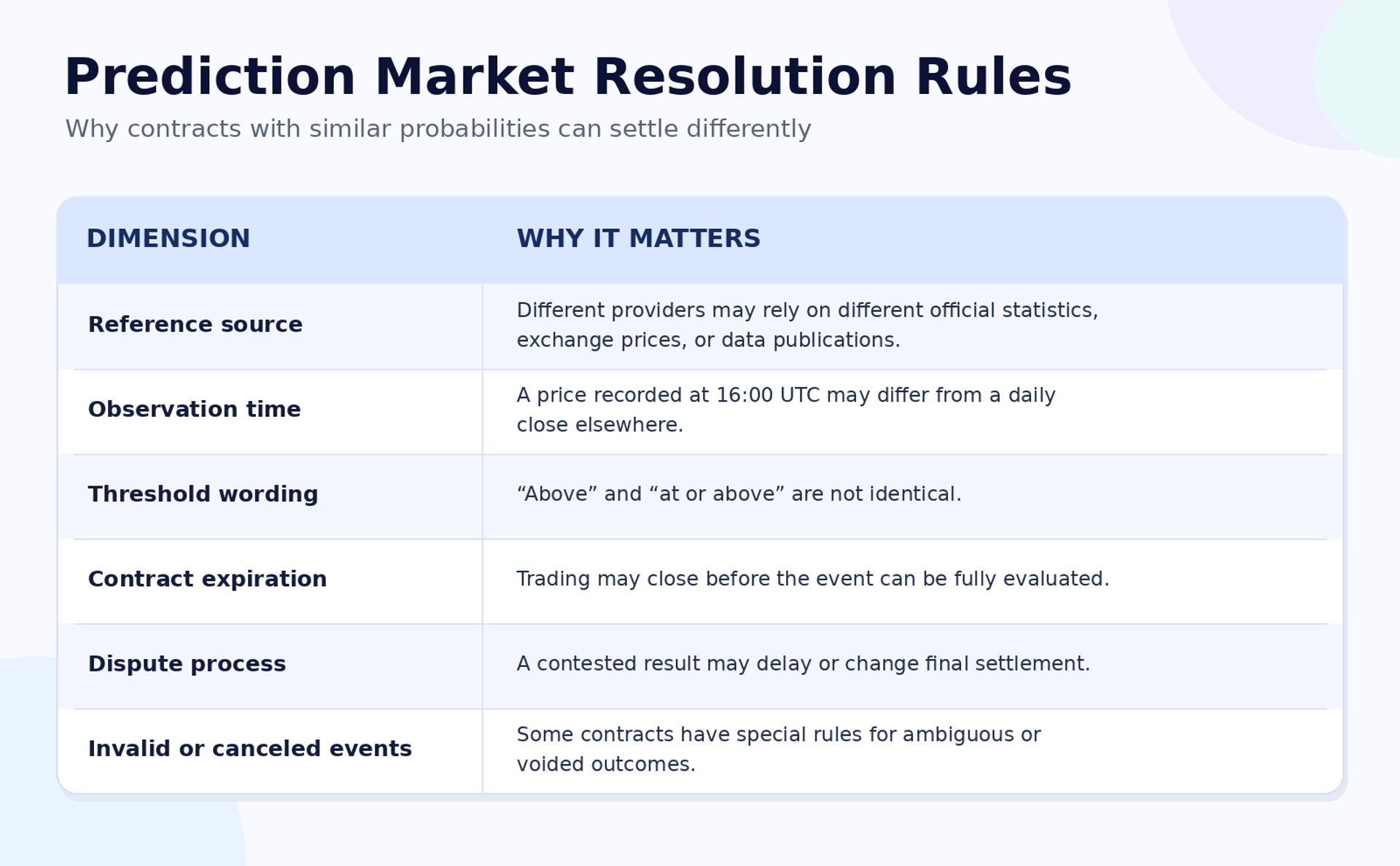
Different resolution mechanisms also change what users are trading.
Polymarket uses oracle-based resolution for its international markets. Kalshi and ForecastEx operate under regulated exchange rulebooks. Manifold's community-created questions have their own resolution conditions.
Consequently, a price discrepancy is not automatically an arbitrage opportunity.
Before comparing probabilities, compare the contracts themselves.
This is especially important when developing forecasting models. Mixing markets with different settlement conditions can make historical results appear inconsistent even when each platform resolved its own contract correctly.
5. Which Prediction Market Platform Fits Your Use Case?
There's no universal winner. The choice depends on what you're trying to do.
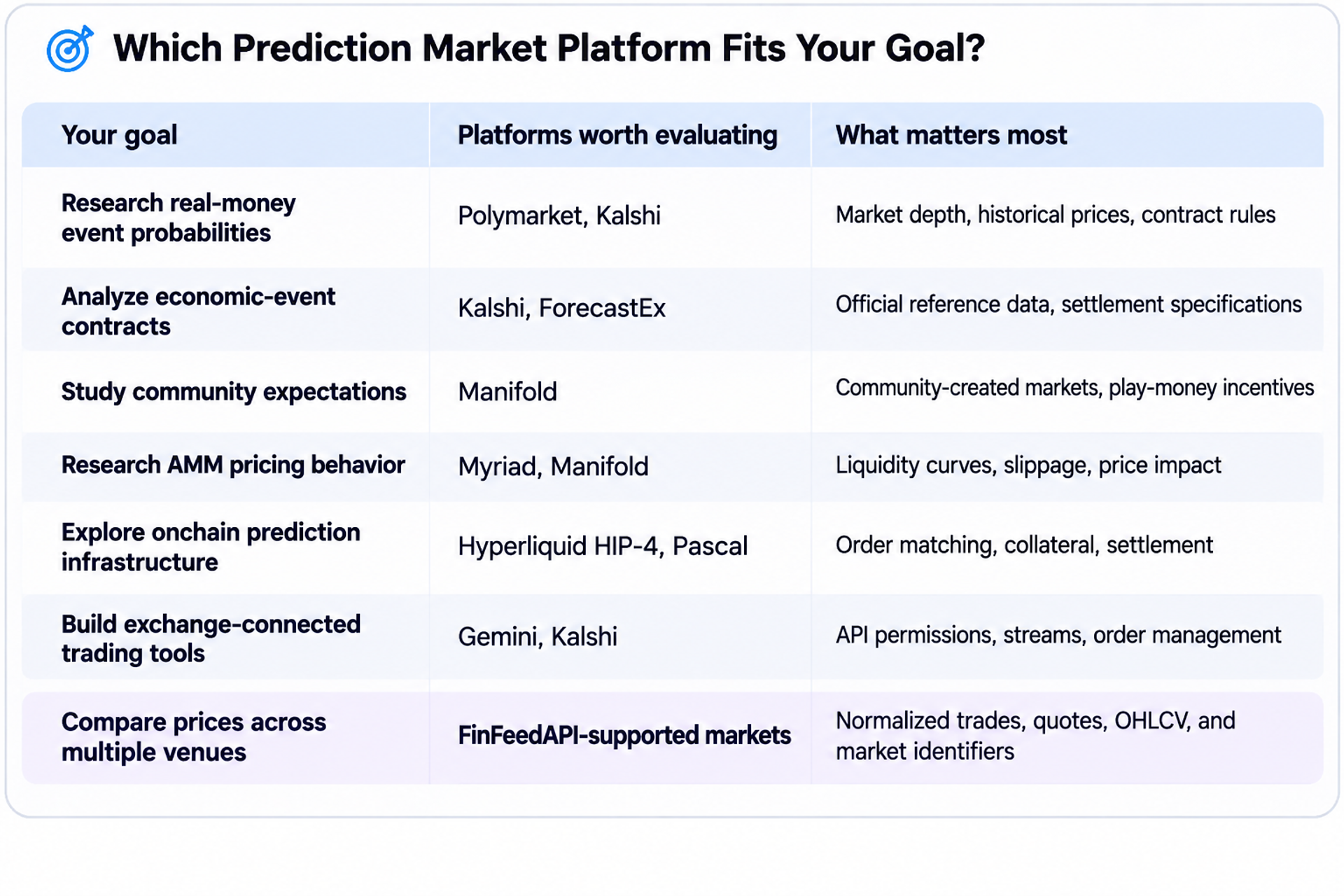
For developers, the harder question often comes after choosing a platform.
What happens when you want to analyze several at once?
Each venue uses its own identifiers, response structure, timestamps, and market definitions.
One exchange may identify a market by a ticker. Another uses a contract ID. Another stores a separate identifier for each outcome.
Even if two questions refer to the same event, their contracts may not have equivalent settlement rules.
This is where normalized market data becomes useful.
Analyze prediction market prices with FinFeedAPI
FinFeedAPI's Prediction Markets API provides a common interface for accessing current and historical prediction-market data across supported venues.
Instead of building a different data pipeline for each exchange, developers can work with consistent exchange IDs, market IDs, and normalized data structures.
The API provides access to:
- Market metadata: Titles, outcomes, identifiers, and market status.
- Trades and quotes: Executed prices, quantities, bid-ask updates, and timestamps.
- Order books: Current liquidity snapshots and historical order updates where supported.
- OHLCV history: Historical price and volume series for analysis and backtesting.
Access is available through REST, JSON-RPC, and MCP for AI-assisted research. FinFeedAPI's Prediction Markets API does not provide WebSocket streaming or execute trades.
Here's a practical workflow for investigating a sudden change in the implied probability of an event.
Step 1: Discover the market
Start by retrieving the supported exchanges.
Select an exchange, then retrieve its historical market listings and identify the relevant outcome-level market_id.
Step 2: Inspect recent trading activity
Replace MARKET_ID with a valid identifier returned during discovery.
The response provides recent trades and quote records, helping you identify whether the probability change coincided with new trades, changed quotations, or both.
Step 3: Examine liquidity
Use the same exchange and market identifiers to retrieve the current order-book snapshot:
Inspect the bid and ask ladders. A large spread or shallow depth may explain why a relatively small trade moved the displayed probability.
For historical reconstruction, use historical order updates where available, rather than treating a current snapshot as historical state.
Step 4: Compare historical behavior
Retrieve OHLCV, trades, or quotes covering the period before and after the event.
For a cross-exchange study, repeat the process for another venue. Match the event definitions, resolution conditions, and outcome directions before comparing the prices.
FinFeedAPI normalizes access to supported market data, but it does not automatically identify equivalent events across platforms. That matching step remains part of the researcher's workflow.
The result is a richer view of how a market reacted, whether liquidity was sufficient, and whether different platforms responded at similar times.
For a deeper technical walkthrough, see How to Get Historical Prediction Market Trades, Quotes and Order Books, Not Just Odds.
The Probability Is the Beginning
Prediction market platforms may look similar from the outside. A question, a percentage, and a YES or NO button.
Underneath, they operate very differently.
Some use traditional order books. Others rely on automated liquidity. Some settle through regulated exchange processes, others through onchain contracts or community-defined outcomes.
Those differences influence prices, spreads, trading costs, and ultimately how much confidence researchers should place in a displayed probability.
For developers building forecasting tools or analyzing how markets react to information, the answer isn't simply to collect more probabilities.
It's to understand the trades, liquidity, timestamps, and resolution rules behind them.
Explore FinFeedAPI's Prediction Markets API to access normalized prediction-market data across supported venues, or start with the documentation.
Related Topics
- Tracking Hyperliquid HIP-4: How to Connect Outcome Markets to Your Crypto Projects
- What Are Hyperliquid Outcome Markets? HIP-4 Prediction Contracts Explained
- Prediction Markets: Complete Guide to Betting on Future Events
- Markets in Prediction Markets
- 10 Things You Should Never Do With Prediction Market Data
- Can Prediction Markets Predict Better Than Polls?
- From Market ID to Resolved Outcome: Implementing a Prediction Market Lifecycle Monitor